
Getting paid in construction shouldn't require a legal research project every month. But for companies working across state lines, that's exactly what happens.
Every state has different rules about when you can formally pursue unpaid invoices. Illinois gives you one window. Texas has a different timing. Some states require preliminary notices. Others don't. Tracking all this manually means someone on your finance team is spending hours each month researching deadlines, calculating days outstanding, and hoping they didn't miss something important.
We built an agent that automates that entire process. It tracks every outstanding invoice, compares it against state-specific requirements, and delivers a scheduled report showing exactly which accounts need attention and what action you can take.
Here's how we did it, and why this approach works for any construction business managing receivables across multiple jurisdictions.
Starting with the Real Problem
Before building anything, we had to understand what makes payment tracking so painful for contractors. The answer came down to two things: volume and variability.
A contractor managing 40 active job sites across five states faces this challenge at scale. Each project has its own completion date, outstanding balance, and payment timeline governed by different state laws.
Someone needs to track all of this. Usually, that falls to a controller or accounting manager who exports project data into a spreadsheet, checks completion dates against a calendar, researches the specific rules for wherever the work happened, and figures out which invoices are approaching critical deadlines.
Then they do it again next month for a completely different set of projects.
Manual tracking creates a visibility gap. Payment issues exist long before they surface. Without automated monitoring, finance teams lack the early warning signals that create space for proactive outreach and friendly resolution.
Building the Agent: Automation Over Administration
The lien tracking agent connects three pieces: your existing project data, state-specific legal requirements, and an automated analysis that runs on a schedule.
Here's the flow:
- Your project management system already tracks what matters. Completion dates, outstanding balances, and job locations. Most construction companies maintain this data because they need it for operations. We just needed a way to export it cleanly.
- The export is straightforward. You export your project data as a PDF from your management system. That's it. No API integrations. No data transformations. One simple export generates the file you need.
- That PDF becomes the input. We built the agent on Cassidy, which reads the export and compares every outstanding invoice against a reference document we maintain. This document contains the specific filing deadlines, notice requirements, and eligibility rules for each state where you operate.
Here's where it gets interesting. Not all contractors are keeping track of their "last working date". Project managers finish a job, move on to the next one, and forget to log the completion date. Final callbacks and minor fixes blur the timeline even more.
But that data is critical. In most states, the eligibility clock starts from the last day of substantive work. The agent needs to know when that clock started to calculate eligibility accurately.
We solved this by building in logic that handles incomplete data. If the last working date field is blank, the agent skips that project and flags it for manual review. It won't generate false urgency based on missing information. The finance team gets a note saying "these projects need completion dates before we can analyze them."
With clean data, the agent performs the complete analysis. It calculates days outstanding from the last working date. It identifies which invoices have crossed the eligibility threshold based on the specific state requirements. It generates the report.
Here's an example of what the output looks like:
"Two projects in Illinois are 98 days overdue: Project #4521 (Oak Street Medical) and Project #4598 (River Plaza Office). Illinois requires notice of intent before formal filing. These projects are now eligible for that notice. After you send the notice, you must wait 10 days before proceeding with formal action."
The report goes straight to email. Your CFO gets it. Your controller gets it. Your accounting manager gets it. Everyone who needs to know about payment risk sees the same information at the same time.
The agent runs monthly, though you can adjust the frequency. Each run takes about three minutes to complete the entire analysis across all your active projects and all the different state requirements.
How Payment Intelligence Changes Finance Work
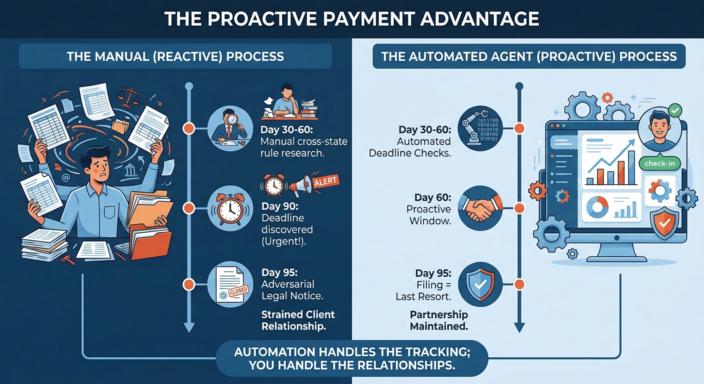
The shift from manual tracking to automated analysis changes what finance teams can do with their time. A controller who might spend six hours per month on manual research could reduce that to 20 minutes of report review and decision-making.
The time savings matter, but the real value is in the visibility. With automated monitoring, you can see payment issues at day 60 instead of day 95. That difference creates space for friendly resolution before formal processes become necessary.
A phone call at day 60 might feel different than a formal notice at day 95. The first conversation is collaborative. "Hey, we noticed this invoice is still outstanding. Is there anything holding up payment on your end?" The second is adversarial. "We're required to send this notice because the deadline has passed."
One approach maintains the relationship. The other strains it.
Finance teams using the agent operate proactively instead of reactively. They reach out while there's still time for simple solutions. They escalate only when necessary. They protect cash flow without burning bridges with clients who drive repeat business.
The pattern applies across construction and related industries. HVAC contractors, electrical companies, specialty suppliers, and installation firms all face the same challenges when tracking payments across multiple jurisdictions. Any business completing work on construction projects benefits from knowing which invoices are approaching deadlines before those deadlines arrive.
What You Need to Know About Implementation
Getting started with payment tracking automation begins with assessing what you already have. Most construction companies track the data they need. They just don't have a system that analyzes it automatically.
Ask your finance team these questions:
- How much time do we spend each month tracking payment deadlines manually?
- How many states do we operate in, and do we know the specific requirements for each one?
- Do our project managers consistently update completion dates in our management system?
- How often are we surprised by payment deadlines we didn't realize had passed?
If your team is spending more than two hours per month on manual tracking, or if you're managing projects across three or more states, automated monitoring delivers immediate value.
Implementation is straightforward. We review what data your project management system tracks and how you export it. We build the state requirements document based on where you operate. We configure the agent to read your exports and perform the eligibility analysis. We set up the monthly delivery to your designated recipients.
The ongoing maintenance is minimal. When state requirements change, the reference document gets updated. When expanding into new states, those requirements are added to the analysis. Your team just needs to keep project completion dates reasonably current, which most already do for operational reasons.
Build Your Payment Intelligence System
Payment tracking reveals something important about where AI creates value in construction. The opportunity isn't in automating decisions about when to escalate or what notices to send. It's in surfacing the right information at the right moment so people can make better decisions about protecting cash flow while maintaining relationships.
The Lien Tracking Agent doesn't make collection decisions. It doesn't send notices automatically. It doesn't escalate accounts without human approval. It handles the tracking across all your projects and all the different state requirements. The people handle the relationships and the judgment calls about when to reach out and how to protect partnerships.
That's what effective AI implementation looks like in industries where relationships matter as much as results. The technology removes the administrative burden. People focus on the decisions that require context, judgment, and an understanding of which partnerships are worth protecting.
If your finance team is spending hours tracking payment deadlines manually, or if you're managing projects across multiple states with different requirements, let's explore whether this approach fits your workflow. We'll review your current tracking process, look at what data you already capture, and show you exactly how automation reduces administrative overhead while improving visibility.
Let's talk about how payment tracking automation could work for your team.