




I've been watching platform shifts for decades now. First in financial services, then building an agency through the digital marketing transformation, and now helping companies navigate AI at SoftSnow.
Nothing crystallized where we are quite like standing in the same keynote room two years in a row.
Same company. Same platform. Same word: AI. Completely different conversation.
Last month, I was back in New York for client meetings, partner conversations, and Microsoft's AI Tour event. This was my second year attending. And what struck me wasn't the new features or the polished demos. It was realizing that the finish line moved while most companies were still trying to cross the starting line.
If you're feeling that tension right now, you're not alone.
What Changed Between 2025 and 2026
Here's what I'm seeing. In 2025, Microsoft's message was simple: "We need to help companies actually start." And honestly? That felt right. Most of my client conversations were still about overcoming that first hurdle. Security concerns. Budget approval. Getting teams comfortable with the idea of AI.
Microsoft positioned Copilot as a universal productivity assistant. Safe, governed, focused on time savings. The recurring message: "You don't need to transform your company to use AI."
That message mattered because that's where most companies were.
Fast forward to 2026. I walked into the keynote expecting updates and refinements. That's not what I got.
The opening frame was different: "Becoming Frontier." Microsoft was no longer easing people in. They were drawing a line between leaders and everyone else.
The central question shifted from "How do you adopt AI?" to "How do you put AI in the flow of human ambition?"
That's when I realized the game changed.
Why Every AI Platform Provider Is Raising the Bar
This shift isn't unique to Microsoft. I'm seeing it across every platform provider, every client conversation.
A few days after the keynote, Satya Nadella posted something on LinkedIn that captured the pace: "We are still in the beginning phases of AI diffusion and its broad GDP impact, and already we've built an AI business that is larger than some of our biggest franchises that took decades to build."
Read that again. Microsoft built an AI business bigger than franchises that took decades to develop, in a fraction of the time.
If that's the pace at the platform level, imagine the pressure on enterprises trying to keep up.
What I've learned through years of transformation work is that these inflection points separate companies quickly. The ones who see them coming have a window to sprint ahead. The ones who don't spend years catching up.
What Microsoft's 'Frontier' AI Strategy Means for Enterprise Leaders
Microsoft gave explicit signals that the bar moved.
Satya frames it this way: "Like in every platform shift, all software is being rewritten. A new app platform is born. You can think of agents as the new Apps."
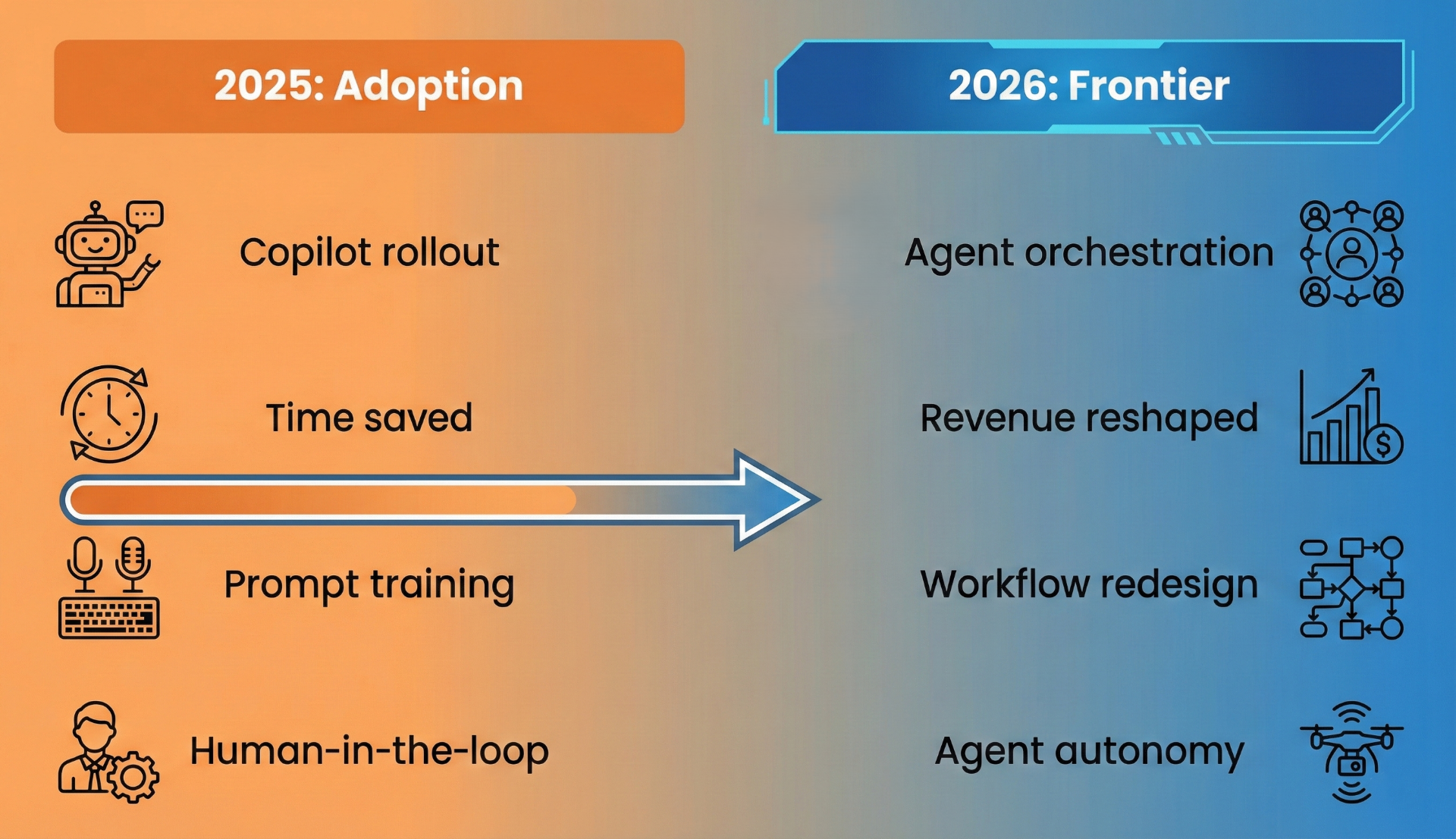
In 2025, success meant fewer emails, shorter meetings, faster documents. In 2026, success means reinvented customer engagement and innovation curves that bend upward.
Microsoft is saying plainly: "AI that only accelerates existing work opens new possibilities for those ready to reimagine how they operate."
I've been in enough client conversations to know what this means in practice. The questions leaders are asking me have changed:
- 2025: "How do we roll out Copilot safely?"
- 2026: "How do we redesign our entire operating model around AI?"
That's a fundamental reframe. Let me make this concrete:
In 2025, a company uses Copilot to summarize support tickets and draft responses faster. That's valuable. In 2026, a Frontier company redesigns its entire support model so agents triage 80% of cases autonomously, escalate only edge cases to humans, and feed structured learning data back into product development. Same technology. Completely different thinking.
What Makes a Company "Frontier"
Microsoft is using the term deliberately. But what does it actually mean in practice?
After dozens of client conversations and watching companies at different stages, here's what I'm seeing separate Frontier companies from everyone else:
- They treat data as product infrastructure: Data architecture gets the same strategic attention as customer experience.
- They design workflows assuming agent participation: They're asking "How would we design this process if intelligent agents were part of the team from day one?"
- They measure AI impact at the system level: Frontier companies track how AI changes cycle times, decision quality, and business model economics.
That's the bar. And it's rising fast.
Why Data Infrastructure Became Critical to AI Success
One of the most telling moments in the 2026 keynote was when Microsoft openly asked: "Do you have the right data foundations for AI to work reliably in your business?"
That question landed differently than typical keynote rhetoric. Data became existential.
Your data strategy is about:
- Master data governance - Who owns what data, and who can access it under what conditions?
- Semantic layer clarity - Do your systems speak the same language, or does "customer" mean something different in sales vs. support?
- Defined data ownership - When AI makes a recommendation based on finance data, who's accountable for accuracy?
- AI-ready metadata strategy - Can your systems explain where data came from and how current it is?
A messy SharePoint limits your AI effectiveness. Inconsistent metrics undermine agent trust. Siloed systems stall autonomy.
Microsoft's stack assumes connected data, governed access, and clear ownership. If that's missing, your AI ceiling stays low regardless of model quality.
This means treating information management as strategic infrastructure. That's an operating model change.
How AI-Ready Organizations Differentiate from Pilot Programs
Some companies are already asking different questions. They're measuring different outcomes. They've made this shift.
What separates them? They're building capability in how they work. AI access is universal now. The readiness to use it effectively is not.
That's the shift Microsoft is making: from democratizing access to differentiating based on execution. And it's happening everywhere.
This shift isn't unique to Microsoft. Google is making similar moves with Gemini and Vertex AI. Anthropic is positioning Claude as enterprise-ready. OpenAI is building toward an enterprise platform. The pattern is consistent: what worked in 2025 (getting started) isn't what wins in 2026 (scaling transformation).
At SoftSnow, we're seeing this play out in real time. The companies thriving aren't the ones with the biggest AI budgets. They're the ones who invested in readiness first.
Two Critical Shifts for Enterprise AI Implementation
If you're building on any major AI platform, here's what I'm seeing create momentum:
- Copilot rollouts are table stakes
If your AI strategy is still "We rolled out Copilot" or "We trained people on prompts" or "We built a few copilots," you're playing last year's game. That work is necessary, but it does not create advantage.
- AI must move from individual wins to organizational design
The biggest shift between those two keynotes is where Microsoft expects AI to live.
In 2025, AI helped people do their jobs. In 2026, AI reshapes how companies operate.
That means redesigning workflows around what AI makes possible, rewriting standard procedures, changing decision-making processes, and letting AI participate rather than merely assist.
This is an operating model change.
Why AI Experimentation Phase Has Ended for Enterprises
What I learned from those days in New York is that the finish line will keep moving.
The platform matters less than understanding the shift: adoption was 2025's goal; transformation is 2026's standard.
I've been doing this long enough to recognize the pattern. Companies that thrive through platform shifts build the capability to move with the changes.
That means treating data as infrastructure. It means redesigning workflows around what AI makes possible. It means investing in how people work alongside these systems. It means building frameworks that can evolve.
The hard truth? The grace period when experimentation was enough has ended.
The opportunity? You can decide how to handle the urgency. Companies turning pressure into clarity are where advantage lives now.
How to Move from AI Pilots to Transformation
Before you close this tab, ask yourself three questions:
- Are we redesigning workflows around AI, or just layering AI on top of existing processes?
- Do our AI systems operate on trusted, structured data with clear governance?
- Are we measuring transformation outcomes, or just productivity gains?
Your answers will tell you whether you're building for 2025 or 2026.
What I've learned through years of transformation work is that the platform pace won't slow down. The expectations won't ease. What changes is whether you're building capability for the last question or the next one.
At SoftSnow, we help companies build that capability through a guided transformation that builds AI fluency while delivering measurable results.
If these questions are surfacing tension you're ready to address, I'd genuinely love to explore what that looks like for your organization.
Let's get to work.